
Many ecommerce sellers feel confident when they handle 30 or 50 orders in a day. Operations seem simple, the team works smoothly, and problems look manageable. But the moment order volume crosses 200, 300, or even 500 in a single day, the entire workflow starts cracking.
Suddenly, issues appear everywhere:
- Order delays increase
- Items get shipped twice or sent to the wrong customer
- Inventory does not match real stock
- More refund and return requests come in
- Customer ratings drop and sales fall
Most of these issues do not come from lack of effort. They come from using a system that was never designed to scale.
An ecommerce business grows quickly, but many sellers continue using the same manual process or basic tools that worked at a smaller stage.
What “Scalable” Actually Means (Most Sellers Misunderstand This)
Most sellers believe scale means automation. Automation is helpful, but scalability goes much deeper.
A scalable ecommerce order management system:
- Handles sudden order spikes during sales or festivals
- Keeps operations smooth even when orders jump overnight
- Supports multiple warehouses and channels
- Stays fast even when thousands of orders arrive at the same time
- Works reliably during heavy traffic days like Diwali, New Year, or Independence Day sales
Scalability is about staying stable under pressure.
If your system collapses whenever order volume increases, it is not scalable.
The Domino Effect: How Poor Order Management Damages Your Entire Business
A weak OMS does not just slow down operations. It affects your entire business performance.
Warehouse Confusion
Staff receives unclear picklists, items get misplaced, and many orders stay unshipped.
Order Errors Increase
Wrong product being shipped is one of the biggest outcomes of poor order management. Every return costs money in shipping, restocking, and time.
Customer Dissatisfaction
Late deliveries or mixed orders lead to negative reviews. Even a few low ratings impact marketplace rankings and organic visibility.
Profit Margin Shrinkage
Inefficiencies silently increase:
- Labour costs
- Return costs
- Storage costs
- Courier penalties
You may be selling more, but earning less.
The 50-Order Problem vs. the 50,000-Order Problem
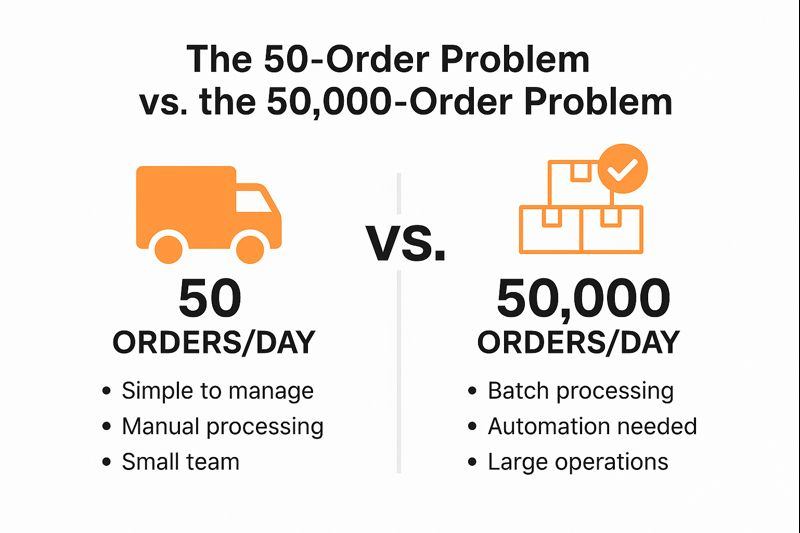
Different stages of growth bring different challenges.
At 50 Orders/Day
- Pick and pack is manageable
- Basic spreadsheets can work
- One warehouse staff may be enough
At 300–500 Orders/Day
- Manual sorting collapses
- Team spends hours correcting mistakes
- Packing speed slows down
- Stocks go wrong across channels
At 5,000–50,000 Orders/Day
- Batch picking becomes mandatory
- Label printing must be automated
- Inventory needs real-time sync
- Multiple teams and warehouses must coordinate
- Even one minute of delay multiplies losses
This is the breaking point for sellers who rely on outdated systems or manual processes.
Key Features of a Truly Scalable Ecommerce OMS
A scalable solution must support the entire fulfillment workflow.
Unified Dashboard
Pulls all orders from all channels into one place. No need to check each portal separately.
Channel Syncing
Inventory updates everywhere instantly.
Prevents overselling and stock shortages.
Bulk Shipping
Allows generating hundreds of labels and invoices at once.
Auto Picklist and Auto Packing
Creates optimised pick routes and packing sequences for the warehouse team.
Smart Inventory Syncing
Auto-adjusts stock as soon as orders come in or returns are processed.
Real-Time Order Tracking
Customers receive accurate updates, reducing customer service load.
Role-Based Access
Ensures controlled access for warehouse staff, accountants, managers, and admins.
Speed, Accuracy and Automation: The Backbone of Scaling
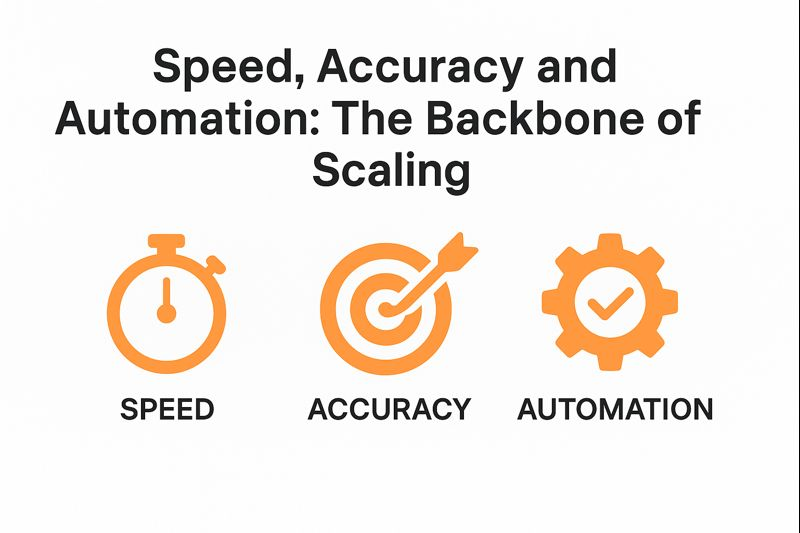
A strong ecommerce order management system improves three key areas.
Speed
Faster processing means lower cost per order and more daily shipments.
Accuracy
Accurate picking and packing reduce mistakes, returns, and customer frustration.
Automation
Automation handles repetitive work, allowing your team to focus on quality and speed instead of manual tasks.
This includes:
- Automated label generation
- Order status updates
- Inventory syncing
- Picklist creation
Automation supports the team but does not replace the need for a well-structured process.
Growth-Proofing Your Business: When Should You Upgrade Your OMS?
Here are the warning signs:
- Your team works overtime during sales
- Orders often get mixed up
- Stock shows wrong numbers on marketplaces
- You depend heavily on spreadsheets
- Your warehouse workflow slows down as orders grow
- Delivery delays become frequent
Volume Thresholds
If your brand crosses 150–200 orders per day, upgrading your OMS becomes essential.
Quick 3-Minute Audit
Ask yourself:
- Do I manually check orders from multiple platforms?
- Does my team take too long to pack?
- Do I face frequent stock errors?
- Do customers ask for order updates often?
If you answer yes to even two points, your current system cannot scale further.
The ROI Angle: How a Scalable OMS Saves Lakhs Every Month
Reduced Manpower Cost
Automation reduces the need for a large team.
Lower Return Ratio
Better accuracy reduces returns and refunds.
Faster Deliveries
Speed improves customer satisfaction and repeat purchases.
Better Inventory Control
Dead stock reduces.
Stock-outs become rare.
You save money on reordering and warehouse storage.
Higher Ratings
Happy customers mean better visibility and better sales on marketplaces.
A scalable OMS not only handles more orders but also significantly increases profit margins.
Sell More, Stress Less
This is where Wisdom OMS becomes extremely valuable for growing ecommerce brands.
It is designed to handle both steady daily volumes and sudden peaks without slowing down your operations. With automated picklists, smart inventory syncing, faster order processing, and a unified dashboard, Wisdom OMS removes the manual workload that often causes delays and errors.
Growing from 50 orders to 500 or even 50,000 is not just about increasing sales. It is about building the right systems to support that growth.
A scalable ecommerce order management system ensures your business remains efficient, accurate, and ready for any order spike.
Leave a Reply